Solkant Kafferosteri
Costa Rica Aquiares
Costa Rica Aquiares
Couldn't load pickup availability
Roast Description / Brewing
We recommend a 1:15 coffee-to-water ratio with water at 90–92°C. This coffee shines especially well as a pour-over, where its character and complexity can really come through, but it also performs beautifully in a batch brewer for a more convenient brew. Adjust the grind and ratio to taste, depending on your preferred extraction and strength.
Delivery Terms
Our coffee is roasted and shipped only between Tuesdays and Thursdays to ensure the best possible quality and freshness. Since each coffee has its own specific profile, roast dates may vary, but we guarantee that it will never be older than two weeks from roast date at the time of delivery. What we can promise is that the coffee will always be fresh and taste great when it reaches you.
History
The name Aquiares means “land between rivers” in the Huetar indigenous language, and Aquiares Estate is commonly referred to as “Aquiares Coffee and Community.” It is the largest farm in Costa Rica and home to 1,800 people. Although the farm was founded in 1890, Alfonso Robelo is the man responsible for its transformation a century later. Alfonso arrived in Costa Rica in the 1980s seeking refuge from the civil war in Nicaragua, where he was politically active. When politics turned violent, he fled the country to protect himself and his family after receiving several threats against his life. In Costa Rica, Alfonso began building the Aquiares community on the enchanting slopes of the Turrialba volcano, a lush area of forests, rivers, fauna, and bright flora.
Alfonso challenged the status quo by transforming the relationship between landowner and farmworkers. He brought a visionary approach to Aquiares, a farm suffering from low prices and instability. More than 200 employee homes existed on the farm, but because workers did not own their homes, there was great insecurity within the workforce. Alfonso saw an opportunity to strengthen the company by giving people a sense of pride and ownership in the coffee they produced. He evolved the farm into a small town where workers could purchase their own homes. Today, Aquiares remains a model of sustainable agriculture.
Today, Alfonso’s son Diego manages the farm. Under his leadership, the farm has taken a fresh approach to specialty coffee and exploring its potential. Through excellent agricultural management, embracing new varieties, and experimenting with processing, Aquiares has become a trailblazer among specialty coffee producers in Costa Rica and Central America.
Aquiares focuses on carbon neutrality and measures its greenhouse gas emissions to calculate emissions against its offsets. An agent verified under International Panel on Climate Change norms verifies these calculations, and Aquiares’ carbon measurement and emissions reduction are part of Costa Rica’s Nationally Appropriate Mitigation Action. In addition to capturing carbon, the farm’s protected biological corridors help ensure the wellbeing of local animals and plants. Aquiares also welcomes researchers from around the world to conduct agricultural and environmental studies on its land. Projects have included investigating the benefits of agroforestry on soil health and observing the diverse bird and wildlife species that thrive in an agroecological environment.
Aquiares is an example of innovation and perseverance whose benefits extend beyond the farm and its workers, serving as a model for sustainable and equitable production in the broader coffee industry. The lots selected by Ally Coffee from Aquiares represent our shared commitment to sustainability, equity, and innovation.
Mariana is an F1 hybrid cultivar closely related to Starmaya. It originates from a cross between IAPAR 59 and a male-sterile Ethiopian landrace variety and is one of the first F1 hybrids in the world to be propagated by seed rather than tissue cloning.
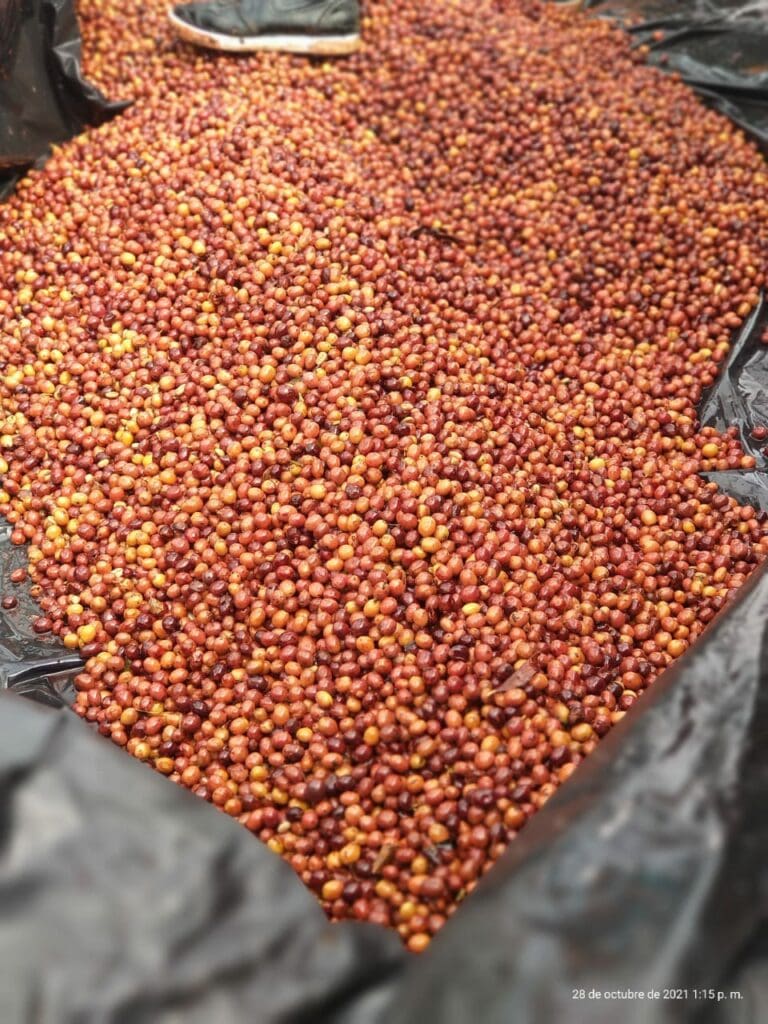
This lot of Mariana coffee underwent Anaerobic Natural processing. The cherries are floated and washed with fresh water but not depulped. They are then placed in a stainless-steel tank with a one-way air valve, where natural microorganisms and yeast begin fermentation. The fermentation pushes out the oxygen, creating an anaerobic environment after one to two hours. Fermentation continues for a total of 24 hours. Afterward, the cherries are washed again with fresh water and dried in a solar dryer. They spend two days first on a ceramic patio and then finish drying on layered beds inside the solar dryer.
Farmer: Diego Robelo
Farm: Aquiares Estate
Region: Turrialba
Variety: Mariana
Altitude: 1200m
Process: Anaerobic Natural
Flavor Profile: Black Cherry & Blackberry
Share